If you manage corporate travel, you've almost certainly had this conversation: a salesperson booked a £620 flight to Frankfurt, your policy says £500, and now you're trying to explain — with a straight face — that the cheaper option was a 14-hour two-stop itinerary leaving at 5:40am. The salesperson is annoyed. Your CFO is annoyed. And the policy that was meant to keep both sides happy has just made everyone unhappy at once.
This is the problem Lowest Logical Fare — usually shortened to LLF — is designed to solve. It's quietly become the standard that modern corporate travel programmes are built on, and if you're still running fixed-pound flight caps in 2026, you're almost certainly overpaying, under-controlling, or both.
This guide explains what LLF actually is, how it's calculated, why it beats fixed caps, and how to set an LLF-based flight policy that your travellers will accept and your finance team will trust.
The short definition
Lowest Logical Fare (LLF) is the cheapest reasonable fare on a specific route and date — not the cheapest fare full stop.
The keyword is reasonable. A pure "cheapest fare" calculation will happily return a fare that nobody in your company would ever actually take: three stops, an overnight in Doha, a 6-hour layover, arriving at 2am the day before the meeting. LLF filters those out. It looks at every flight available on the route and date, removes the obviously unreasonable options, and reports the lowest fare from what's left.
You then set your travel policy as a percentage above LLF — for example, "allow up to 30% over LLF" — and the cap moves with the market.
A worked example
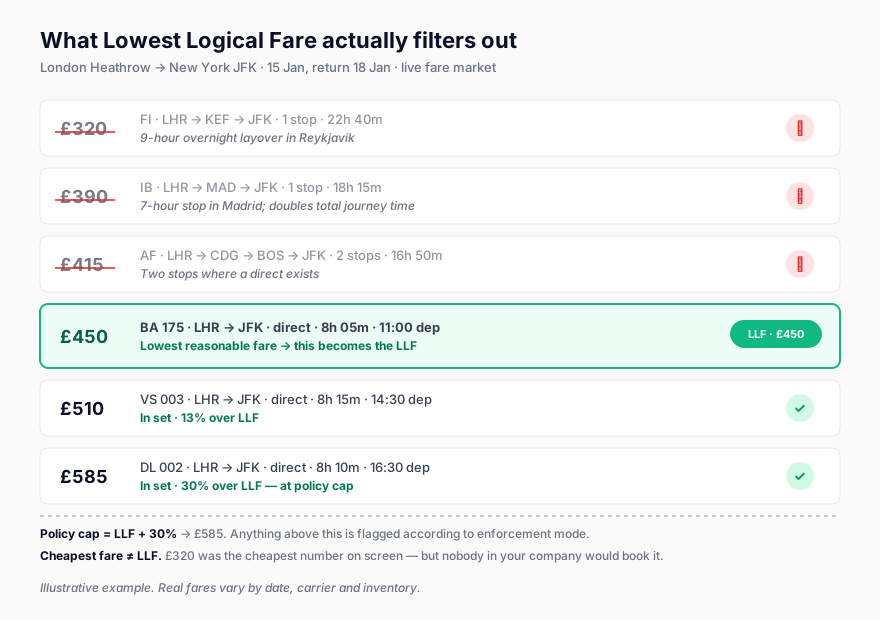
Imagine an employee needs to fly London Heathrow → New York JFK on 15 January, returning 18 January. Helix queries the live flight market for that exact route and date pair and finds 47 fare combinations. The very cheapest is £320 — but it routes via Reykjavik with a 9-hour overnight layover. The next cheapest is £390 with a 7-hour stop in Madrid. Neither is something you'd put a senior account manager on for a one-night client meeting.
After filtering out unreasonable itineraries, the lowest remaining fare is £450 — a direct British Airways flight at a sensible hour. That £450 becomes the LLF for this trip on this date.
If your policy is "30% over LLF", the cap for this booking is £585. The traveller can pick anything up to £585 — direct or 1-stop, BA or Virgin or Delta — without triggering a violation. Anything over £585 is flagged according to whatever enforcement you've configured.
Now imagine the same employee books the same route a month later, in mid-February, when prices have softened. The LLF drops to £310. The cap drops with it, to £403. No spreadsheet update. No policy review meeting. The market did the work.
That second part — the cap moves with the market — is the whole game.
Why fixed flight caps don't work
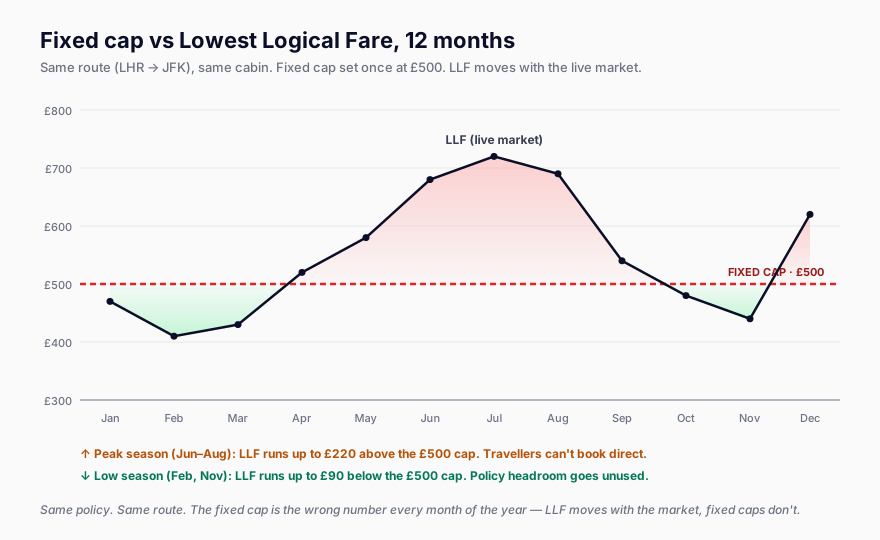
Most travel programmes still run on fixed numbers: "£500 to anywhere in Europe", "£1,200 to North America", maybe a slightly more granular grid by region. They're easy to write down and easy to enforce, which is why they've survived. But they fail in three predictable ways.
They go stale within weeks. Airline pricing is dynamic. A £500 cap to a European destination might be wildly generous in November and physically impossible in mid-July. Setting a fixed cap is like setting a fixed budget for "groceries" — fine on average, useless on any given day. Travel managers end up either rewriting the grid every quarter or watching compliance silently collapse during peak season.
They punish geography. A single "Europe cap" treats London → Lisbon and London → Zurich as the same trip. They aren't. Direct return fares to Zurich routinely run 60–80% higher than to Lisbon for structural reasons that have nothing to do with the traveller's choices. Fixed caps either over-fund the cheap routes (wasted policy headroom) or under-fund the expensive ones (constant violations from people who genuinely had no cheaper option).
They damage trust. When a policy is obviously detached from reality, travellers stop taking it seriously. Once that happens, even the rules that do make sense get ignored. The single biggest predictor of compliance isn't enforcement — it's whether travellers believe the policy is fair.
LLF fixes all three. Caps refresh per booking. Geography is priced in automatically. And travellers can see exactly which itineraries set the benchmark, so the number feels grounded rather than arbitrary.
How LLF is actually calculated
A robust LLF calculation isn't just "lowest price on the screen". Modern LLF engines apply a series of filters to define what reasonable means for your programme. The exact rules vary by provider, but the standard set looks like this:
The engine pulls every available fare for the requested route and date pair from live airline inventory — typically via NDC connections or aggregators that cover the major full-service carriers and most meaningful low-cost ones. From that raw set, it filters out itineraries with extreme connections (typically anything over 5–6 hours of layover time, or more than one stop when a direct exists), itineraries that arrive overnight or at unreasonable hours given the trip purpose, and fares in the wrong cabin class for the trip pattern. What's left is the logical set. The lowest fare from that set is the LLF.
Two details matter here:
Expanded benchmark windows. A traveller searching for a specific 09:00 departure from Heathrow will see a different set of fares than the benchmark needs to look at. Good LLF engines compute the benchmark over an expanded window — typically ±3 hours either side of the requested time — so the cap reflects the real lowest reasonable price on that day, not a number a traveller could manipulate by searching narrow time slots. This is what makes LLF a benchmark rather than a search result.
Frozen benchmarks. Once a traveller starts a booking, the LLF for that trip is frozen against the trip record. If prices move during the 20 minutes they're choosing, the cap doesn't move underneath them mid-booking. The frozen benchmark is also what the approver sees later — so everyone is looking at the same number and there's no "the price was different when I picked it" argument.
These two details are what separate a real LLF implementation from a marketing claim. Ask any travel platform you're evaluating how they handle benchmark windows and benchmark freezing — the answer tells you whether their LLF is real or theatre.
Setting your LLF policy: the percentages that actually work
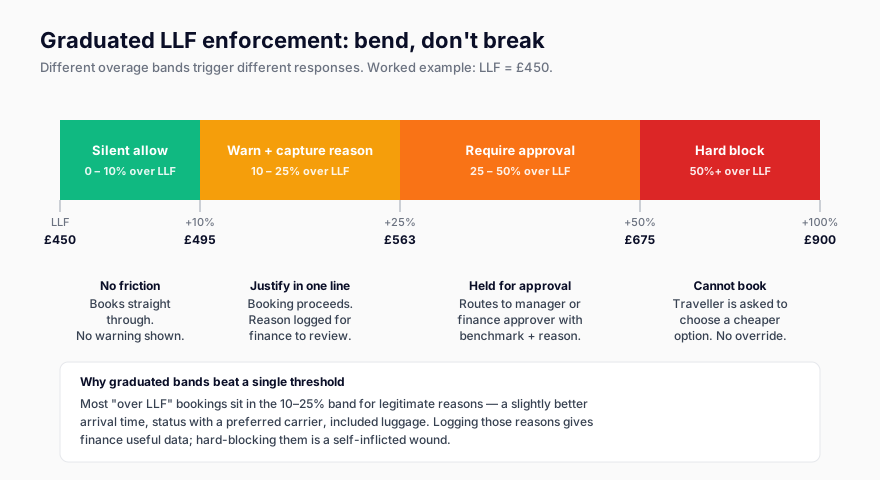
A common mistake is treating LLF as a single number ("we allow X% over LLF and that's the rule"). The strongest programmes use graduated enforcement: different percentages trigger different responses, so the policy bends rather than breaks.
A typical graduated LLF policy looks like this:
Up to 10% over LLF — silent allow. Travellers can book anything in this band without seeing a warning. This range exists because the lowest reasonable fare and the best reasonable fare often differ by single-digit percentages — a slightly better arrival time, an airline the traveller has status with, a fare class with included luggage. Forcing people to defend this gap creates noise without saving meaningful money.
10–25% over LLF — warn and require justification. The booking proceeds, but the traveller has to provide a one-line reason. The reason is logged against the booking and visible to finance. The bulk of "over LLF" bookings sit in this band, and the justification logs become genuinely useful data — patterns emerge that tell you whether to revise your fare class rules or add a preferred-airline carve-out.
25–50% over LLF — require approval. A manager or finance approver has to sign off. The booking goes on hold and routes to the right approver based on the user group hierarchy. The approver sees the LLF, the traveller's choice, the gap, the justification, and a one-click approve or reject. Done well, most approvals happen within minutes.
Over 50% — hard block. No booking, no override, choose something cheaper. This band exists for absolute outliers.
Graduated LLF policies typically deliver 18–30% reductions in average flight spend versus fixed-cap policies, mostly by closing the unforced overpayments at the bottom of the curve rather than by blocking booking attempts at the top. The savings are quiet, continuous, and don't require any new traveller behaviour.
What LLF doesn't do
LLF is a cap mechanism, not a complete policy. It tells you what price is reasonable; it doesn't tell you which airlines you prefer, what cabin class is allowed for which trip lengths, what your sustainability rules are, or how far ahead bookings need to be made. A complete flight policy combines LLF with rules for cabin class by duration (e.g. economy under 6 hours, premium economy 6–8 hours, business over 8), preferred and blocked carriers, max stops, and advance-booking windows.
It also doesn't replace human judgement on edge cases. A board member flying to a closing meeting has a different cost profile to a graduate scheme analyst flying to a training week. The strongest programmes use LLF with user groups and approval chains so the rules can flex by role without anyone having to maintain a spreadsheet of exceptions.
What "good" looks like in practice
A well-implemented LLF programme should feel almost invisible to travellers. They search a route, see a benchmark figure quoted alongside the options, and understand at a glance why one fare is "in policy" and another isn't. Approvers should see exactly the same numbers later — the benchmark, the selection, the gap, the reason — without any "the price was different when I picked it" arguments. And travel managers should be spending their time on the genuinely interesting questions — route mix, preferred airline negotiations, advance booking incentives — rather than manually updating a fare grid every quarter.
If you're evaluating tools, the questions to ask are: is the benchmark computed over an expanded time window, is it frozen against the trip at booking start, does the approver see the same number the traveller saw, and how is "reasonable" actually defined in the filter logic? The answers will tell you whether you're looking at real LLF or a marketing wrapper around a fixed cap.
FAQ
Is Lowest Logical Fare an industry standard?
LLF has been used by global travel management companies (TMCs) for over twenty years, originally as a manual benchmark agents applied during fare quoting. What's new in 2026 is real-time, automated LLF computation for every booking — not just the ones that reach a human agent.
How is LLF different from "cheapest fare"?
Cheapest fare is the absolute lowest number on the screen, regardless of itinerary quality. LLF filters out fares with unreasonable connections, overnight layovers, excessive total travel time, or wrong fare class for the trip pattern, then takes the lowest of what remains. In practice, LLF is usually 15–40% higher than absolute cheapest fare — and is the number anyone in your company would actually book.
Can travellers manipulate LLF by searching narrow time windows?
Not in a well-implemented system. Helix computes the benchmark over an expanded ±3 hour window regardless of the traveller's exact search, so the LLF reflects the real market for the day rather than a cherry-picked subset.
What percentage over LLF should I allow?
Most successful programmes run 10% silent allow / 25% warn / 50% require approval, but the right numbers depend on your route mix and traveller seniority. Start with the standard graduated policy and tune after 60 days of real bookings.
Does LLF work for premium cabins?
Yes — LLF can be computed within a fare class. If your policy allows business class on flights over 8 hours, the LLF for those routes is computed against the lowest reasonable business class fare, not economy. The percentage cap then applies on top of that benchmark.